Computing and Information Science and Technology
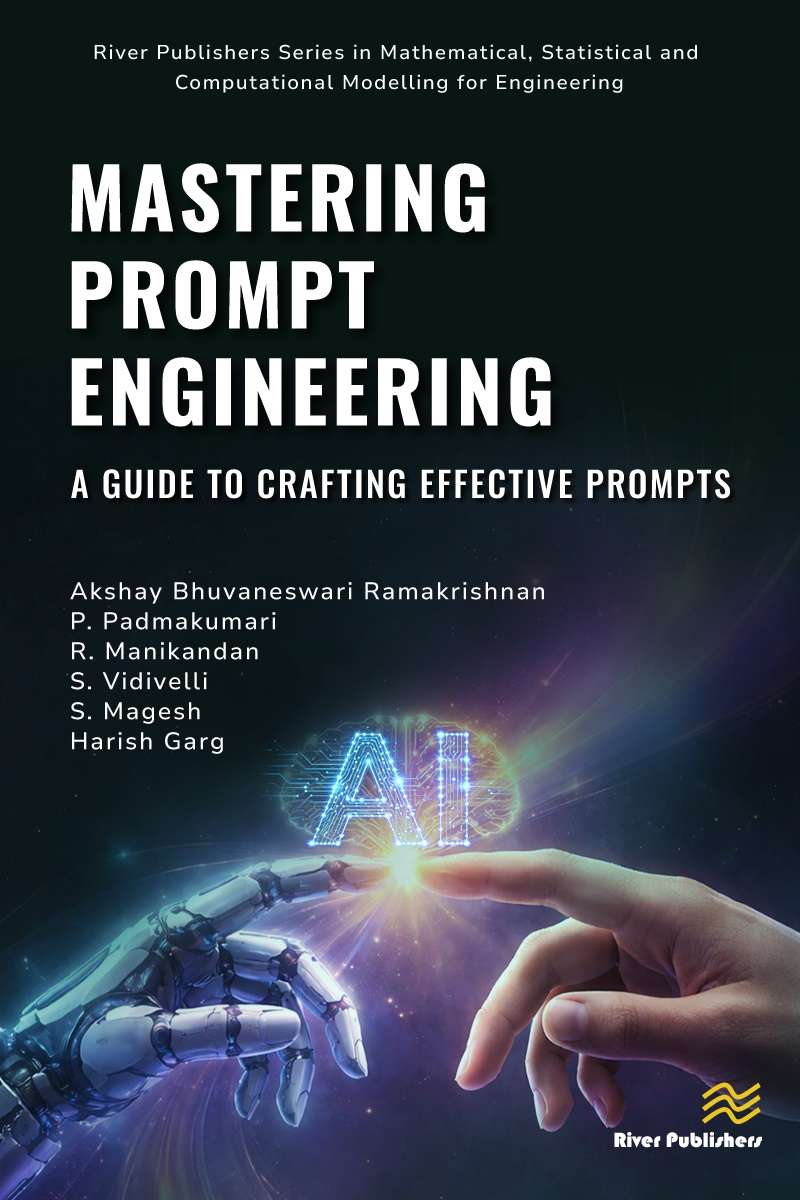
Mastering Prompt Engineering
A Guide to Crafting Effective Prompts Forthcoming
Authors:
Akshay Bhuvaneswari Ramakrishnan, Johns Hopkins University, USA
P. Padmakumari, SASTRA Deemed University, India
R. Manikandan, SASTRA Deemed University, India
S. Vidivelli, SASTRA Deemed University, India
S. Magesh, Dr. M. G. R. Educational and Research Institute, India
Harish Garg, Thapar Institute of Engineering & Technology, India
ISBN: 9788743813668 (Hardback) e-ISBN: 9788743813675
Available: October 2026
This book explains the principles, structure, and real-world practice of prompt engineering in a way that anyone working with large language models can understand and apply. Rather than treating prompting as a collection of hacks, it walks the reader through how to think about role, context, task, constraints, and examples so that LLMs produce reliable, domain-appropriate outputs. Starting from the basics of “what is a prompt,” the book then connects prompting to how generative AI models actually work, introduces core and advanced prompting patterns (prompt chaining, dynamic templates, tool-augmented prompting), and shows how to evaluate and refine model responses.
Designed for students, educators, and practitioners, each chapter includes learning objectives and hands-on exercises that can be tried directly in tools like ChatGPT. Later chapters move from theory to application, demonstrating how to build LLM-powered chatbots and retrieval-augmented generation (RAG) systems, and how to incorporate ethics, safety, and bias awareness into prompt design. By the end, readers will have a reusable toolkit for crafting effective prompts across education, research, business, and technical use cases.
Chapter 1: Introduction to Prompt Engineering
Chapter 2: Understanding Generative AI
Chapter 3: The Basics of Prompt Design
Chapter 4: NLP Foundations for Prompt Engineering
Chapter 5: Language and Communication in Prompt Design
Chapter 6: Advanced Prompting, Evaluation, and Validation
Chapter 7: Ethical and Responsible Prompt Engineering
Chapter 8: Building LLM-powered Applications (Chatbots and RAG)
Chapter 9: Exploring Prompts with ChatGPT
Chapter 10: Future Directions in Prompt Engineering