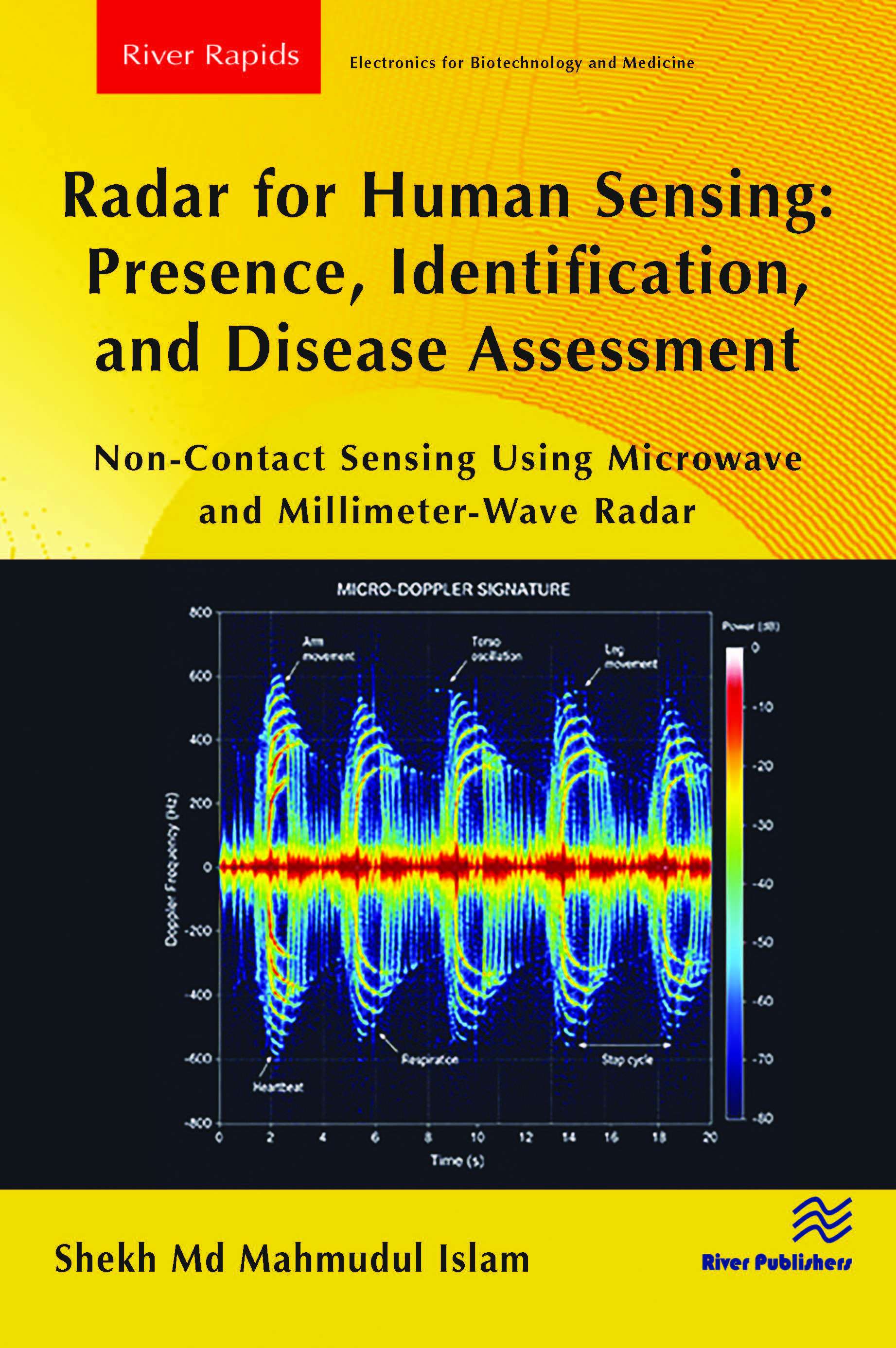
Radar for Human Sensing: Presence, Identification, and Disease Assessment
Non-Contact Sensing Using Microwave and Millimeter-Wave Radar
Electronics for Biotechnology and Medicine
Radar for Human Sensing: Presence, Identification, and Disease Assessment
Non-Contact Sensing Using Microwave and Millimeter-Wave Radar Forthcoming
Editor: Shekh Md Mahmudul, Islam, Ph.D., University of Dhaka, Bangladesh
ISBN: 9788743815716 (Paperback) e-ISBN: 9788743815723
Available: November 2026
Radar is a rapidly transforming technology traditionally associated with defense and automotive systems into a powerful platform for intelligent, human-centered sensing. Advances in microwave and millimeter-wave radar hardware, sophisticated signal processing, and machine learning now make it possible to detect human presence, recognize identity and activity, and monitor physiological conditions—all without physical contact or reliance on cameras. Robust, unobtrusive, and inherently privacy-preserving, radar-based human sensing is opening new possibilities across healthcare, smart environments, assisted living, security, and emerging intelligent systems.
This book provides a comprehensive and unified exploration of this rapidly advancing field, connecting foundational radar principles with state-of-the-art sensing technologies and real-world applications. Readers are guided through electromagnetic fundamentals, radar system architectures, Doppler and micro-Doppler analysis, advanced signal processing, and data-driven modeling techniques, establishing the knowledge needed to understand, design, and develop next-generation human-sensing systems.
Key application areas include occupancy and presence detection, radar-based human identification, activity recognition, and non-contact physiological monitoring for health and disease assessment. The book examines both structural sensing approaches, including microwave imaging, and functional techniques, such as Doppler-based cardiopulmonary monitoring. By presenting these complementary methods within a coherent framework, it offers a broad perspective on how radar can capture meaningful information about human identity, behavior, movement, and physiological state.
Designed for graduate students, researchers, and practicing engineers working in radar systems, biomedical engineering, wireless sensing, signal processing, machine learning, and related fields, this book bridges the gap between fundamental theory and practical innovation. Serving as both an accessible introduction and a comprehensive technical reference, it equips readers to advance radar technologies that support continuous, contactless, privacy-conscious, and ethically responsible human sensing.
As intelligent systems become increasingly integrated into everyday life, radar offers a compelling pathway toward sensing technologies that are not only accurate and resilient but also unobtrusive and respectful of personal privacy. This book provides the interdisciplinary knowledge and technical foundation needed to help shape that future.
Preface
1 Introduction
1.1 Background and Motivation
1.2 Human Sensing: Concepts and Scope
1.2.1 Information Measured in Human Sensing
1.2.2 Human Traits and Sensing Taxonomy
1.2.3 Sensor Modalities for Human Sensing
1.2.4 Challenges in Human Sensing
1.2.5 Advantages of Radar-Based Human Sensing
1.3 Radar for Human Sensing: Application Domains
1.3.1 Presence Detection and Occupancy Sensing
1.3.2 Tracking and Localization
1.3.3 Activity Monitoring
1.3.4 Human Identification and Biometrics
1.3.5 Disease Assessment and Health Monitoring
1.3.6 UAV-Based Remote Life Sensing
1.4 About This Book
2 Basics of Radar for Human Sensing
2.1 Introduction to Radar Systems
2.2 Radar Waveforms and Operating Principles
2.2.1 Continuous-Wave Radar
2.2.2 Frequency-Modulated Continuous-Wave Radar
2.2.3 Pulsed Radar
2.3 Doppler and Micro-Doppler Phenomena
2.4 Radar Measurement Fundamentals
2.4.1 Range, Velocity, and Resolution
2.4.2 Angle Estimation and Beamforming
2.5 Radar Architectures for Human Sensing
2.6 Summary
3 Radar-Based Human Presence Detection
3.1 Background and Motivation
3.2 Occupancy and Presence Sensing Fundamentals
3.3 Conventional Occupancy Sensors and Limitations
3.4 Continuous-Wave Radar for Presence Detection
3.5 FMCW and UWB Radar for Occupancy Sensing
3.6 Performance Comparison and Practical Considerations
3.7 Summary
4 Radar-Based Human Identification
4.1 Principles of Radar-Based Biometric Sensing
4.2 Physiological Motion Extraction
4.3 Feature Extraction and Representation
4.4 Machine Learning and Deep Learning Methods
4.5 Multimodal and Cross-Modality Fusion
4.6 Performance Evaluation and Benchmarking
4.7 Summary
5 Non-Contact Radar-Based Disease Assessment and Monitoring
5.1 Introduction to Radar-Based Health Monitoring
5.2 Microwave Imaging for Structural Disease Assessment
5.3 Doppler Radar for Functional Physiological Monitoring
5.4 Radar-Derived Digital Biomarkers and Machine Learning
5.5 Emerging Clinical Applications
5.6 Challenges, Ethical Considerations, and Future Directions
5.7 Summary