Energy Engineering and Systems
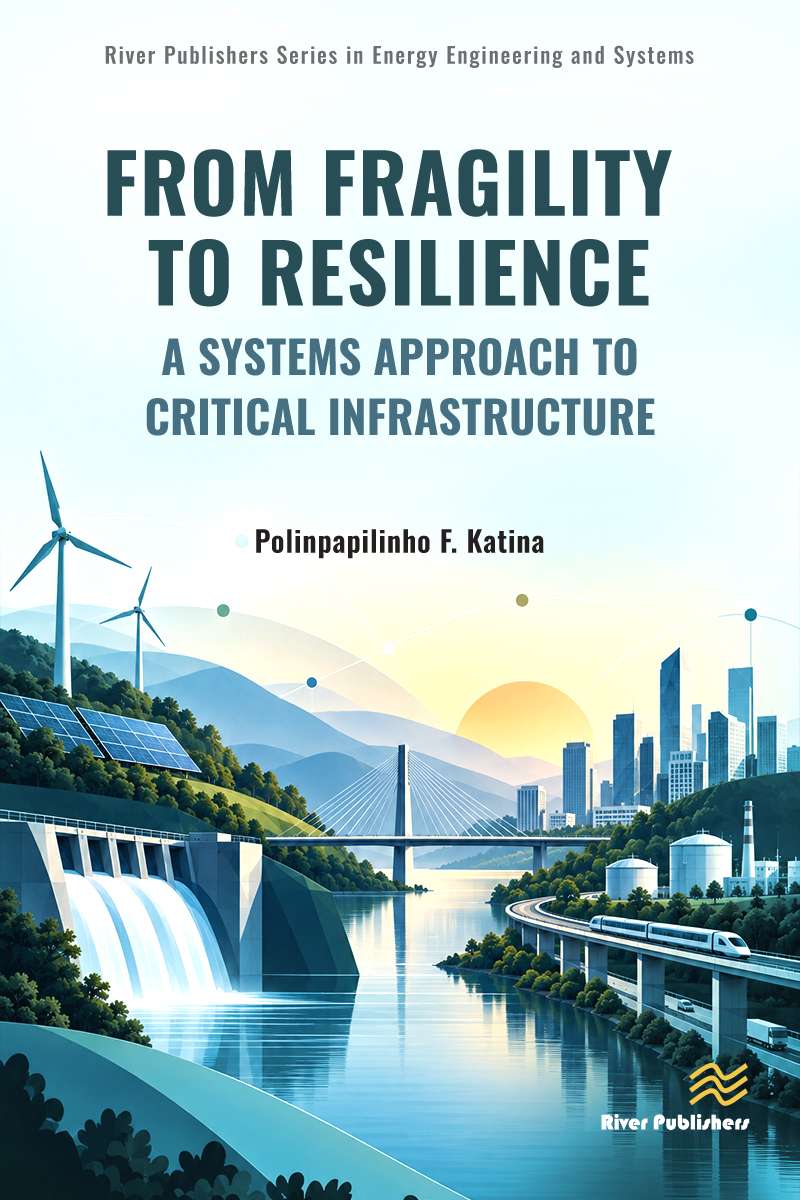
From Fragility to Resilience
A Systems Approach to Critical Infrastructure Forthcoming
Editor: Polinpapilinho F. Katina, University of South Carolina Upstate, USA
ISBN: 9788743816546 (Hardback) e-ISBN: 9788743816553
Available: February 2027
From Fragility to Resilience: A Systems Approach to Critical Infrastructure provides a comprehensive examination of the systems, networks, assets, facilities, and services essential to the functioning of modern society and the global economy. Drawing on systems theory, complexity science, and systems-of-systems thinking, the book explores how increasingly interconnected critical infrastructures can be better understood, governed, protected, and strengthened.
Today's critical infrastructures operate in environments defined by volatility, uncertainty, complexity, and ambiguity (VUCA). Energy, water, transportation, communications, healthcare, finance, manufacturing, government, food systems, defense, and emergency services face evolving natural, technological, environmental, human-made, and cyber-physical threats. Because these systems are deeply interdependent, disruption in one sector can rapidly cascade across others, amplifying consequences for public safety, economic stability, national security, and social continuity.
In this environment, resilience requires more than protecting individual assets. It demands adaptive governance, systems integration, data-informed decision-making, sustainable planning, and the capacity to anticipate, absorb, recover from, and adapt to disruption. This edited volume brings together current research on the methodologies, tools, technologies, frameworks, and strategies needed to address these challenges.
Topics include systems-of-systems engineering, complex systems governance, cyberworthiness of cyber-physical systems, adaptive systems practices, artificial intelligence and augmented analytics, additive manufacturing security, healthcare integration, sustainable supply chains, and AI-enabled food redistribution. Together, these perspectives demonstrate how systems thinking can translate into practical approaches for strengthening infrastructure across sectors.
Bridging theory, methodology, technology, and application, From Fragility to Resilience provides a roadmap for transforming critical infrastructure from fragmented and vulnerable systems into more resilient, adaptive, sustainable, and governable networks. It is an essential resource for researchers, engineers, infrastructure managers, policymakers, project management professionals, practitioners, and students working to strengthen the systems on which modern society depends.
Foreword
Preface
Acknowledgment
About the Editor
List of Contributors
Part I: Foundations for Critical Infrastructure as Systems-of-Systems
1 Chapter I: System of Systems Engineering: A Next Generation Framework
2 Chapter II: System of Systems Governance for Resilience: Embedding Adaptive Systems Practice in Critical Infrastructure Project Management Offices
3 Chapter III: Mixed Methods Study Design – The Utility of Complex Systems Governance in Determining the Cyberworthiness of Cyber-Physical Systems
Part II: Governance, Resilience, and AI-Enabled Infrastructure
4 Chapter IV: AI for resilient production and industrial infrastructures: A vuca-oriented systems perspective
5 Chapter V: Innovative Business and Data Analytics System Approaches to Artificial Intelligence: Empowering Non-Technical Users through Augmented Analytics
Part III: Sector-Specific Critical Infrastructure Applications
6 Chapter VI: From Fragmentation to Integration: A Governance-Oriented Architecture Based on Heterogeneous Interactions in Healthcare Systems-of-Systems
7 Chapter VII: Securing Multi-Tenant Additive Manufacturing in Critical Infrastructure Systems
8 Chapter VIII: A Framework for Sustainable Supplier Selection under the Dynamic Agricultural Yields Challenge
9 Chapter IX: ZINOVA: An AI-based food redistribution platform for reducing food waste
Index of Terms (TO BE DEVELOPED AFTER THE PROOF)
Back matter