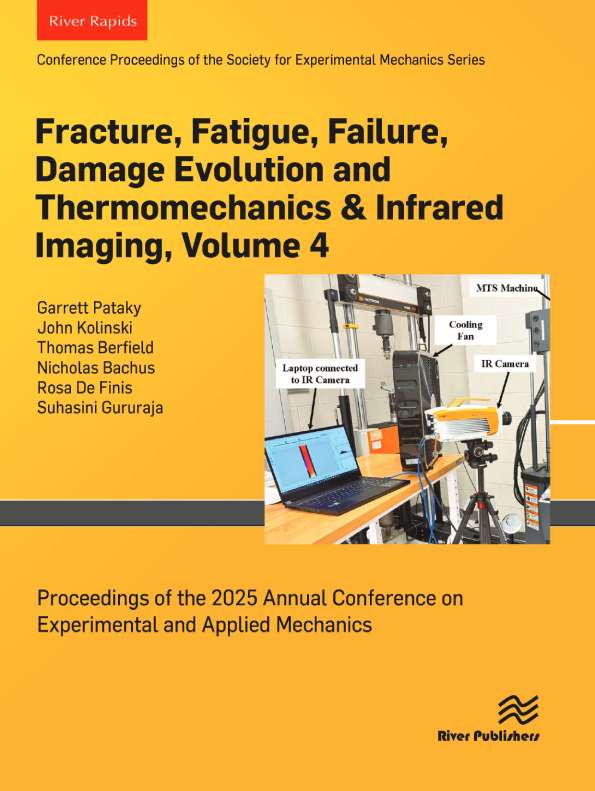
Fracture, Fatigue, Failure, Damage Evolution and Thermomechanics & Infrared Imaging, Vol. 4
Proceedings of the 2025 Annual Conference
on Experimental and Applied Mechanics
River Publishers Series in Conference Proceedings of the Society for Experimental Mechanics Series
Fracture, Fatigue, Failure, Damage Evolution and Thermomechanics & Infrared Imaging, Vol. 4
Proceedings of the 2025 Annual Conference
on Experimental and Applied Mechanics
Editors:
Garrett Pataky, John Kolinski, Thomas Berfield, Nicholas Bachus ·
Rosa De Finis and Suhasini Gururaja
ISBN: 9788743808305 e-ISBN: 9788743808350
Fracture, Fatigue, Failure, Damage Evolution and Thermomechanics & Infrared Imaging represents one of five volumes
of technical papers presented at the SEM 2025 SEM Annual Conference & Exposition on Experimental and Applied Mechanics
organized by the Society for Experimental Mechanics and held in Milwaukee, WI, June 2-5, 2025. The complete
Proceedings also includes volumes on: Dynamic Behavior of Materials; Challenges in Mechanics of Time-Dependent Materials;
Advancement of Optical Methods & Digital Image Correlation in Experimental Mechanics; Mechanics of Biological
Systems and Materials and the Mechanics of Composite, Hybrid & Multifunctional Materials; and Mechanics of Additive &
Advanced Manufacturing, Inverse Methods and Machine Learning.
Each collection presents early findings from experimental and computational investigations on an important area within Experimental Mechanics, Fracture and Fatigue being one of these areas.
Fatigue and fracture are two of the most critical considerations in engineering design. Understanding and characterizing fatigue and fracture has remained as one of the primary focus areas of experimental mechanics for several decades. Advances in experimental techniques, such as digital image correlation, acoustic emissions, and electron microscopy, have allowed fordeeper study of phenomena related to fatigue and fracture.
This volume contains the results of investigations of several aspects of fatigue and fracture such as microstructural effects, the behavior of interfaces, the behavior of different and/or complex materials such as composites, and environmental and loading effects. The collection of experimental mechanics research included here represents another step toward solving the long-term challenges associated with fatigue and fracture. In recent years the applications of infrared imaging techniques to the mechanics of materials and structures has grown considerably. The expansion is marked by the increased spatial and temporal resolution of the infrared detectors, faster processing times, much greater temperature resolution and specific image processing. The improved sensitivity and more reliable temperature calibrations of the devices have meant that more accurate data can be obtained than were previously available.
Each collection presents early findings from experimental and computational investigations on an important area within Experimental Mechanics, Fracture and Fatigue being one of these areas.
Fatigue and fracture are two of the most critical considerations in engineering design. Understanding and characterizing fatigue and fracture has remained as one of the primary focus areas of experimental mechanics for several decades. Advances in experimental techniques, such as digital image correlation, acoustic emissions, and electron microscopy, have allowed fordeeper study of phenomena related to fatigue and fracture.
This volume contains the results of investigations of several aspects of fatigue and fracture such as microstructural effects, the behavior of interfaces, the behavior of different and/or complex materials such as composites, and environmental and loading effects. The collection of experimental mechanics research included here represents another step toward solving the long-term challenges associated with fatigue and fracture. In recent years the applications of infrared imaging techniques to the mechanics of materials and structures has grown considerably. The expansion is marked by the increased spatial and temporal resolution of the infrared detectors, faster processing times, much greater temperature resolution and specific image processing. The improved sensitivity and more reliable temperature calibrations of the devices have meant that more accurate data can be obtained than were previously available.
Thermomechanics, Energy-based methods, Fatigue, Adhesive bonding, IRT, DIC, quasi-static tensile
Article 2: Effect of Induced Porosity on Fatigue Performance of
Additively Manufactured Short-Fiber Thermoplastics Using
Infrared Thermography
by Harsh Gandhi, Pharindra Pathak, Suhasini Gururaja
https://doi.org/10.13052/97887-438-0830-5_2