open
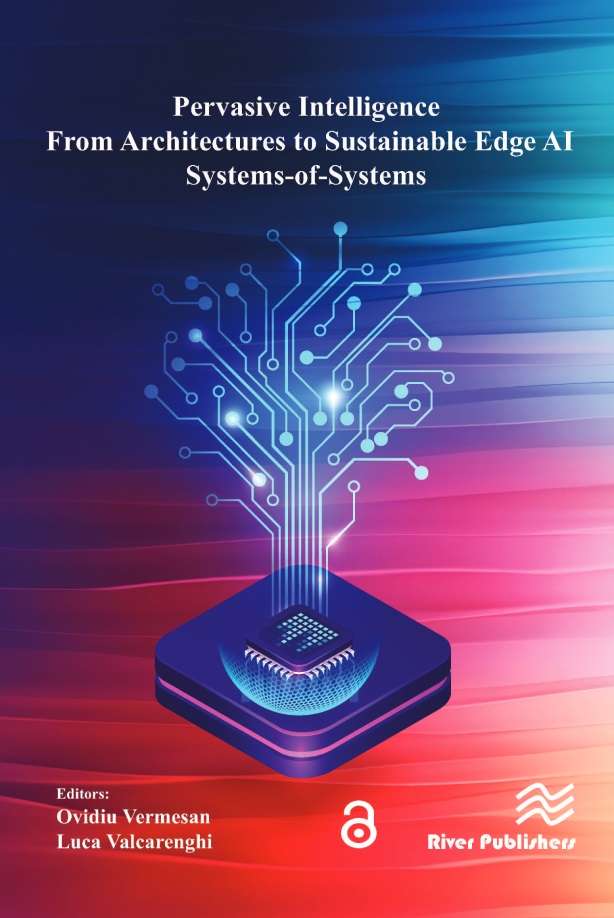
Pervasive Intelligence - From Architectures to Sustainable Edge AI Systems-of-Systems
Editors:
Ovidiu Vermesan, SINTEF, Norway
Luca Valcarenghi, Scuola Superiore Sant'Anna, Italy
ISBN: 9788743815198 (Hardback) e-ISBN: 9788743815204
Available: June 2026
Artificial intelligence is rapidly moving beyond centralized cloud computing into distributed edge environments, creating a new generation of intelligent systems that are autonomous, adaptive, efficient, and sustainable. Pervasive Intelligence: From Architectures to Sustainable Edge AI Systems-of-Systems explores the technologies, architectures, and engineering methodologies driving this transformation.
Written by leading researchers and industry experts, the book provides a comprehensive examination of edge AI, covering topics such as embedded AI acceleration, active inference agents, hardware-software co-design, distributed orchestration, privacy-preserving intelligence, and sustainable computing. It bridges theory and practice by addressing key deployment challenges, including real-time speech enhancement, neural network optimization for embedded devices, AI benchmarking on ARM processors, FPGA-based acceleration, and trustworthy AI systems operating at the edge.
A recurring theme is the emergence of edge AI systems-of-systems, in which intelligent agents, sensors, devices, and computing resources collaborate seamlessly across the edge-to-cloud continuum. The book highlights the importance of interoperability, resilience, trustworthiness, adaptive autonomy, and energy efficiency in building next-generation intelligent infrastructures.
Drawing on practical applications in robotics, autonomous systems, surveillance, smart agriculture, environmental forecasting, and cyber-physical systems, the contributors demonstrate how pervasive intelligence is transforming industries and enabling more responsive, data-driven decision-making. By combining advances in artificial intelligence with systems engineering, control theory, and physics-informed modeling, this volume offers both a strategic vision and a technical framework for the future of sustainable edge intelligence.
An essential resource for researchers, engineers, system architects, and advanced students, this book provides the knowledge and tools needed to design, deploy, and manage intelligent systems operating at the edge.
Written by leading researchers and industry experts, the book provides a comprehensive examination of edge AI, covering topics such as embedded AI acceleration, active inference agents, hardware-software co-design, distributed orchestration, privacy-preserving intelligence, and sustainable computing. It bridges theory and practice by addressing key deployment challenges, including real-time speech enhancement, neural network optimization for embedded devices, AI benchmarking on ARM processors, FPGA-based acceleration, and trustworthy AI systems operating at the edge.
A recurring theme is the emergence of edge AI systems-of-systems, in which intelligent agents, sensors, devices, and computing resources collaborate seamlessly across the edge-to-cloud continuum. The book highlights the importance of interoperability, resilience, trustworthiness, adaptive autonomy, and energy efficiency in building next-generation intelligent infrastructures.
Drawing on practical applications in robotics, autonomous systems, surveillance, smart agriculture, environmental forecasting, and cyber-physical systems, the contributors demonstrate how pervasive intelligence is transforming industries and enabling more responsive, data-driven decision-making. By combining advances in artificial intelligence with systems engineering, control theory, and physics-informed modeling, this volume offers both a strategic vision and a technical framework for the future of sustainable edge intelligence.
An essential resource for researchers, engineers, system architects, and advanced students, this book provides the knowledge and tools needed to design, deploy, and manage intelligent systems operating at the edge.
Pervasive intelligence, edge AI technologies, edge AI systems, systems of systems, edge AI systems reference architecture, edge AI technology stack, micro-edge, deep-edge, and meta-edge, artificial intelligence (AI), edge AI accelerators, deep learning (DL), machine learning (ML), federated learning (FL), edge AI trustworthiness, AI explainability (XAI), AI interpretability (IAI), interconnection networks.
1 Edge AI System-of-systems Reference Architecture Engineering Foundations and Multi-dimensional Views
2 Towards Smart and Adaptive Agents for Active Sensing on Edge Devices
3 Prediction of Neural Network Latency on Embedded GPU Accelerators
4 Closing the Gap Between AI Models and Silicon: Application Deployment for Next-generation Edge Accelerators
5 Multichannel Speech Enhancement under Low-latency Constraints: Balancing Quality and Computational Cost
6 Pareto Optimal Benchmarking of AI Models on ARM Cortex Processors for Sustainable Embedded Systems
7 Improving Classifier Latency at the Edge through ARM Helium
8 Structural Sensitive-attribute Leakage in Face Recognition Embeddings for Edge AI Deployments
9 TinyHLS, a Python-based Hardware Compiler for 1D and 2D Convolutional Neural Networks
10 Fair AI Experimentation on Edge Device Clusters via Distributed Orchestration in dAIEdge-VLab
11 Physics-informed Kalman Filtering for Multi-step Bias Correction in Indoor Temperature Forecasting
2 Towards Smart and Adaptive Agents for Active Sensing on Edge Devices
3 Prediction of Neural Network Latency on Embedded GPU Accelerators
4 Closing the Gap Between AI Models and Silicon: Application Deployment for Next-generation Edge Accelerators
5 Multichannel Speech Enhancement under Low-latency Constraints: Balancing Quality and Computational Cost
6 Pareto Optimal Benchmarking of AI Models on ARM Cortex Processors for Sustainable Embedded Systems
7 Improving Classifier Latency at the Edge through ARM Helium
8 Structural Sensitive-attribute Leakage in Face Recognition Embeddings for Edge AI Deployments
9 TinyHLS, a Python-based Hardware Compiler for 1D and 2D Convolutional Neural Networks
10 Fair AI Experimentation on Edge Device Clusters via Distributed Orchestration in dAIEdge-VLab
11 Physics-informed Kalman Filtering for Multi-step Bias Correction in Indoor Temperature Forecasting